The range door would not close flush and heat was rolling out of the top corner. He shimmed the hinge and fitted a new door seal that had been crushed flat. The kitchen stopped baking when the oven runs.
Anders L.2026-05-16
Independent Viking kitchen appliance repair · Ponte Vedra Beach, FL
Mon–Fri 8–6 · Sat 9–4 +1 (904) 775-7957
Viking service
Sealed burners, simmer settings, oven thermostats and the salt-pitted cast iron that comes with living three miles from the Atlantic.
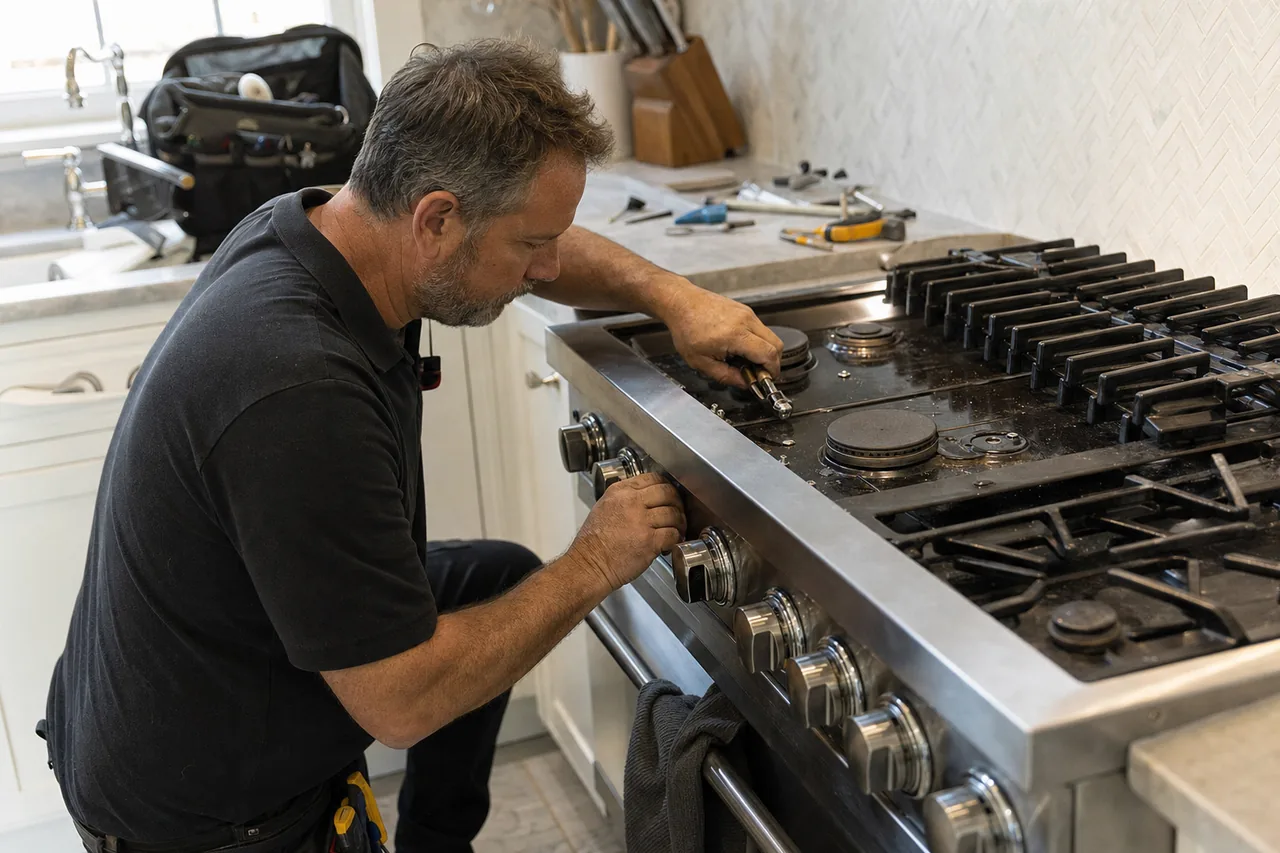
A Viking range is a heavy, serviceable machine. That is the good news: almost every part on it is designed to be replaced rather than potted, glued or moulded in. Most of what goes wrong in 32082 is an ignition problem, a calibration problem, or corrosion, and the three want different work.
Sealed surface burners light from a spark electrode sitting a few millimetres from the burner ports. Three things stop that working, and you can usually narrow it down before we arrive.
If every burner clicks continuously, including the ones that are switched off, there is moisture or spill residue holding a switch closed. A boil-over that ran under a burner cap is the classic cause. Drying the area thoroughly and leaving the cooktop apart overnight fixes a surprising number of these.
If one burner clicks and never lights, the ports next to the electrode are blocked or the cap is out of position. A burner cap that is off its seat by a millimetre puts the ports somewhere the spark cannot reach. If it clicks, the cap is seated, and the ports are clear, the fault is upstream in the valve or the supply.
If nothing clicks at all, the spark module or its supply is the place to look, and that is a meter job rather than a guesswork job.
The low-flame setting on a professional burner is a small, deliberate flame held at the very bottom of the valve’s range. It is also the first thing to suffer when the ports are partially blocked or the air shutter is out of adjustment. A burner that is fine on high and dies on low is telling you the flame is starved, not that the valve is broken. Cleaning the ports with a soft brush and a pin — never a drill bit, which enlarges them permanently — restores most of these.
We start with a thermometer in the cavity and a meter on the ignition circuit, because those two tests separate the majority of complaints from each other in under twenty minutes.
In a gas oven, the igniter is also the safety device. Current flowing through the glow bar is what opens the gas valve. An ageing igniter still glows orange, still looks healthy, and no longer draws enough current to open the valve — so the symptom is a glowing igniter, no flame and a cold oven. Judging that by eye is how people end up replacing a perfectly good valve.
In an electric oven, drift usually traces to the temperature sensor. Most Viking ovens allow a small calibration offset. A cavity that is twelve degrees out is often a calibration adjustment; a cavity that is thirty degrees out is a component fault.
Salt aerosol settles overnight on anything horizontal. On a range that is the grates, the burner caps and the top edge of the door. Once the porcelain is chipped, the cast iron underneath starts to bloom, the bloom lifts more porcelain at the edge of the chip, and a bloomed grate will not sit flat again. Replacing the grate set is often cheaper than repeatedly degreasing and sealing a set that has already gone.
The same salt reaches the door hinge springs and the trim fasteners. A hinge that has stiffened on one side lets the door hang open a fraction at the top, the gasket stops sealing along that edge, and the control area above the door runs hotter than designed. Door alignment is checked on every range visit for that reason.
We work in the booked window, protect the floor and the counter, and pull the range forward on its rollers where the fault needs rear access. Testing comes before parts. You get a written estimate before anything is ordered, the diagnostic fee is flat and credited toward the repair when you approve it, and the parts we supply are genuine OEM.
If your range sits in a tight cabinet run with a stone backsplash returned to the sides, mention it when you book. That changes how the unit comes out and occasionally how long the appointment takes.
Symptoms
What it costs
Flat $80 diagnostic covering the visit and the full diagnostic sequence, credited toward the repair once you approve the work. After that the work falls into bands, and these are the bands that fit this page — parts and labour together, before tax. Nothing above $80 is charged until you have the written figure in your hand and have said yes to it.
| The work | Typical total |
|---|---|
| Diagnostic visit, credited toward the repair | $80 |
| Oven thermostat or heating element | $190–$550 |
| Igniter or burner assembly | $200–$530 |
| Control board or touch panel | $410–$1,000 |
The spread inside a band is mostly the part, not the hour: the same fault on two machines can want a sensor or a whole assembly. Where a repair would land above $1,000 we say so before ordering anything, and we say it beside what a replacement would cost rather than leaving you to look it up. The full table and what the fee buys, and where a repair stops being worth doing.
Related
$80 flat diagnostic fee, credited toward the repair when you approve the work.
90 days on our labour, 365 days on the parts we supply. Genuine OEM parts.
Questions
Owner feedback
4.2 out of 5 from 80 customer reviews. Each one below is a single visit, written by the person who paid for it. Read all 80.