The lower zone drifted warm while the top one held. He went to the damper and the zone fan first rather than the compressor, found the fan stalled on a worn bearing and changed it. Both zones hold now.
Ignatius H.2026-08-24
Independent Viking kitchen appliance repair · Ponte Vedra Beach, FL
Mon–Fri 8–6 · Sat 9–4 +1 (904) 775-7957
diagnosis
Symptom-first checks for a Viking wine cooler, from zone settings and door seals to airflow and display codes, and the point where an owner should stop.
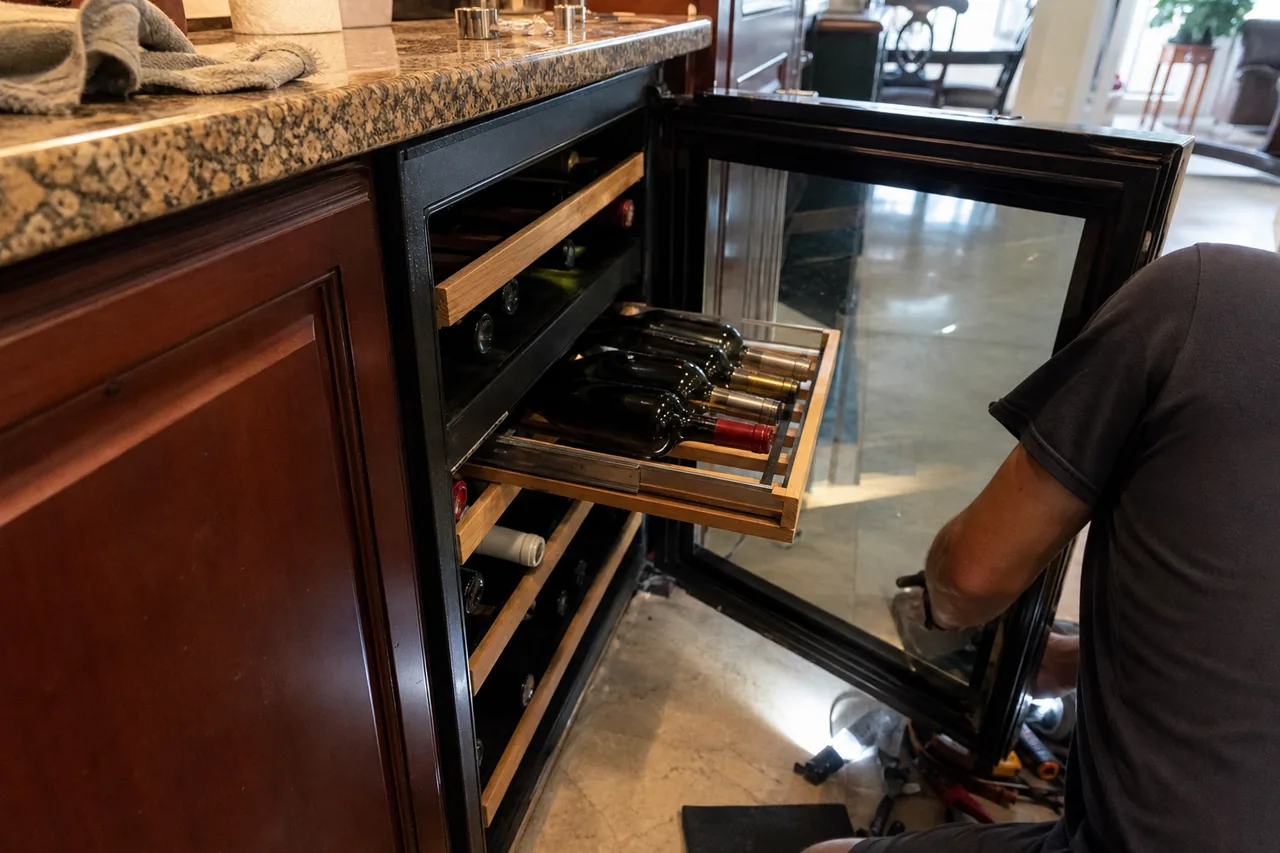
Most Viking wine cooler problems come down to four things, best checked in this order: a setting that does not suit the bottles, a door that is not closing tight, blocked airflow at the front grille, and only then a fan or refrigeration fault. Confirm both zone settings, test the gasket, reseat every shelf and vacuum the grille. An HH or LL code on an undercounter FWUI5242G is different: the cabinet is telling you one zone has been too warm or too cold for hours, so book a technician rather than nudging the controls again.
Plenty of wine cooler complaints turn out to be settings, not failures. Viking suggests holding most wine at roughly 55°F, with reds comfortable between 55 and 60°F and sparkling or most whites happier from 45 to 55°F. Humidity of 60% to 75% keeps corks from shrinking.
The controls have limits of their own. On the FWUI5242G, each zone can be set anywhere from 38° to 65°, but the lower zone is not allowed to sit colder than the upper one, or more than 20° warmer than it. Ask the bottom zone to chill champagne while the top holds cellar temperature and the unit refuses, which looks like a fault but is not. Swap which zone holds which bottles.
The integrated FDWCIC cellars in the VEIL line run two independent zones from 39°F to 64°F and hold within 1°F of the setting, so a swing of several degrees on one is a real clue.
Warmth is the most common complaint, and it usually starts at the door. Look for a flattened or torn section of gasket, then shut the door on a strip of paper at a few points. If the paper slides out with no drag, that part of the seal has failed. Pull each shelf forward and push it fully home, because a bottle neck or a shelf off its runners can hold the glass slightly open. The FWUI5242G helps here: leave its door open past 30 minutes and it sounds a tone once a minute.
Next, give the unit room to breathe. Undercounter cellars move air through the grille at floor level, and a rug edge, a dropped towel or pet hair can choke it. Vacuum it with a brush attachment. In Ponte Vedra Beach homes near the ocean, humid salty air films that grille and the coil behind it, so look every few months.
If the seal holds, the grille is clear and the zone still climbs over a full day, listen. A silent cabinet with a warm interior points to a fan or compressor that is not starting.
A zone running colder than set often traces back to a forgotten setting change, so read both displays first. Ice on the rear wall or half-frozen bottles suggest a sensor or control problem. LL on the FWUI5242G means the compartment has stayed below its setting for an extended time, and Viking’s direction at that point is to contact service.
Water is a separate issue. A little fog on the outside of the glass on a sticky afternoon is normal. Pooling on the cabinet floor or droplets running down the back wall usually mean warm air is slipping past the gasket, or the small drain at the rear has clogged.
A soft hum, the odd click and a brief gurgle after the compressor stops are all normal. Rattling often comes from a bottle touching the back wall or a loose shelf, so reseat it and listen again. Steady buzzing or grinding from the base is more likely a fan blade catching on something or a motor wearing out.
If the display goes dark, test the outlet with a lamp and check the breaker before anything else. Unplugging the cooler for a few minutes and plugging it back in is a fair reset to try once.
| Symptom | Likely cause | What you can check | When to call a technician |
|---|---|---|---|
| One zone a few degrees warm | Door not sealing or shelf in the way | Paper test on the gasket, reseat shelves | Still warm after a day |
| Both zones warm, cabinet silent | Fan or compressor not starting | Clear the grille, confirm power | Straight away |
| HH or LL on an FWUI5242G | Zone off its setting for a long time | Settings and door | When the code returns |
| Water pooling inside | Air leak or blocked drain | Gasket condition, door closing fully | Water keeps coming back |
Stop once these checks are done and the problem remains, or at once if you see oil near the compressor, smell burning or find the cabinet warm and silent.
A visit starts with an $80 diagnostic that pins down the fault. As a typical range, fan or defrost repairs land around $250–$630, a control board or touch panel around $410–$1,000, and compressor or sealed-system work around $890–$2,470, with the firm figure given after diagnosis. Check the purchase date before budgeting, because sealed-system coverage on wine units ends after year 6. Harbour Row Service handles Viking wine cellar repair across St. Johns County.
What it costs
Flat $80 diagnostic covering the visit and the full diagnostic sequence, credited toward the repair once you approve the work. After that the work falls into bands, and these are the bands that fit this page — parts and labour together, before tax. Nothing above $80 is charged until you have the written figure in your hand and have said yes to it.
| The work | Typical total |
|---|---|
| Diagnostic visit, credited toward the repair | $80 |
| Refrigeration fan or defrost system | $250–$630 |
| Compressor or sealed-system repair | $890–$2,470 |
| Control board or touch panel | $410–$1,000 |
The spread inside a band is mostly the part, not the hour: the same fault on two machines can want a sensor or a whole assembly. Where a repair would land above $2,470 we say so before ordering anything, and we say it beside what a replacement would cost rather than leaving you to look it up. The full table and what the fee buys, and where a repair stops being worth doing.
Related
$80 flat diagnostic fee, credited toward the repair when you approve the work.
90 days on our labour, 365 days on the parts we supply. Genuine OEM parts.
Questions
Owner feedback
4.2 out of 5 from 80 customer reviews. Each one below is a single visit, written by the person who paid for it. Read all 80.